
Structured equity offers sponsors a refinancing solution while providing investors downside protection and equity-like upside
Since 2022, commercial real estate transaction volume has fallen by more than 50 percent from its prior peak. Sponsors that acquired and developed properties during the near-zero interest rate era are now facing loan maturities at valuations below their original basis. Many cannot refinance the full balance at prevailing rates and face a narrow set of options: A cash-in refinancing, a sale that recognizes a material loss, or foreclosure.
Structured equity investors have stepped in to address that gap. This form of capital allows sponsors to retain ownership and avoid locking in losses through GP-led recapitalizations at the asset level (distinct from GP-led secondaries). It also can give senior lenders the ability to restructure a loan on their books while maintaining relationships with borrowers.
The math behind the gap
The scale of the problem is significant. The Federal Reserve raised its benchmark interest rate 11 times in less than two years beginning in 2022, and even with subsequent cuts, rates have remained elevated. Federal Reserve chair Kevin Warsh’s hawkish remarks at the Federal Reserve’s August 2026 Jackson Hole symposium suggest elevated rates could persist. As a result, a property acquired in 2021 with 65 percent financing that has since declined by as much as 25 percent in value, a shift consistent with Green Street’s Commercial Property Price Index, could now be leveraged above 90 percent against its existing loan — a level that a replacement lender generally will not underwrite.
A cash-in refinancing typically follows. New equity is contributed to bring the loan back to a serviceable level. This cash infusion does not fund growth or improvements, but without fresh capital, the sponsor’s remaining equity may be further impaired. MSCI estimates approximately $600 billion in commercial real estate loans are scheduled to mature in 2026, with another roughly $550 billion in 2025 maturities having been extended rather than resolved, bringing the total volume potentially coming due in 2026 to about $1.15 trillion (see “How structured equity fills the capital gap” below).
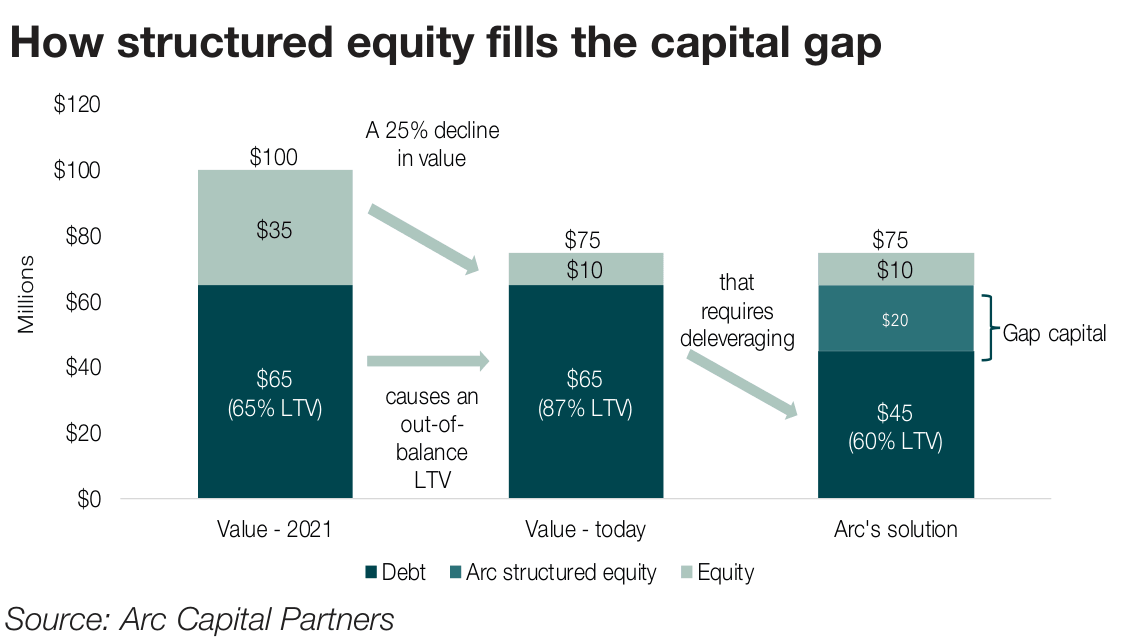
How structured equity fills the capital gap
Beyond debt or equity
Structured equity offers an alternative to traditional equity and debt solutions for assets that need to delever with gap capital. Mezzanine debt, by contrast, carries fewer governance rights and no upside participation. In other words, mezzanine lenders rank behind senior debt and absorb losses first, without the same control rights or participation in asset-level upside that structured equity investors can negotiate.
Many mezzanine providers also borrow against their own fund or balance sheet to enhance returns, layering additional debt onto a position that is already subordinate within the investment. Pricing on this capital has not adjusted enough to compensate for either risk, remaining in the low double digits even as the cost of senior debt has risen sharply across the yield curve since 2022.
Structured equity investments can benefit from both a reset basis and strong governance. A discounted basis provides downside protection at the asset level, while negotiated governance rights over business plans give structured equity investors the ability to proactively protect their position rather than rely on basis alone. More than 70 percent of Arc’s middle-market portfolio is structured in this manner, as preferred or participating preferred equity rather than traditional common equity or subordinated structured debt.
This combination allows investors to mitigate downside through both governance and basis while getting paid for solving a capital constraint for the sponsor in a collaborative manner.
The approach can also provide flexible equity solutions that support value creation with experienced operators, rather than relying on a trading strategy built around buying distressed assets. A sponsor seeking a capital solution is not looking for a misaligned counterparty or a competitor to take the asset. It is looking for a partner willing to work through the business plan on terms that reflect the investment opportunity today.
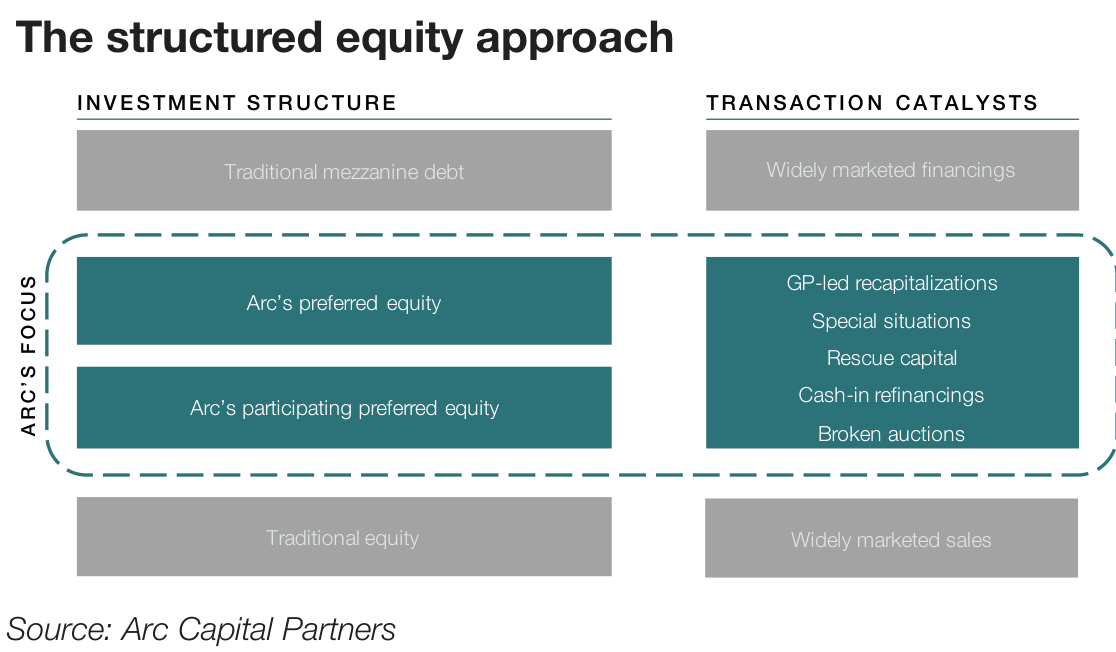
The structured equity approach
The middle-market edge
The largest pools of institutional capital rarely compete for middle-market deals. Middle-market investments range from $30 million to $100 million in gross asset value, and roughly 88 percent of transactions across necessity retail, attainable housing and advanced manufacturing are below $100 million in value, according to CoStar data. This dynamic leaves multibillion-dollar institutional funds effectively confined to a much smaller portion of the market, where competition is intense.
Middle-market assets are often perceived as subscale, even though they represent a deep pool of opportunity for structured equity solutions.
Sponsor ownership at this scale is also highly fragmented, which often requires off-market negotiations to achieve innovative capital outcomes. Middle-market sponsors are more likely to rely on regional banks, debt funds or bridge lenders than on the direct institutional relationships available to larger owners. While financing conditions have improved from the immediate post-2022 pullback, access can still vary considerably by lender, asset type and borrower profile.
This combination of fragmented ownership and a more fragmented financing base creates a repeatable opportunity set for capital providers purpose-built to source and structure new investments off market through long-standing sponsor relationships rather than broadly marketed processes.
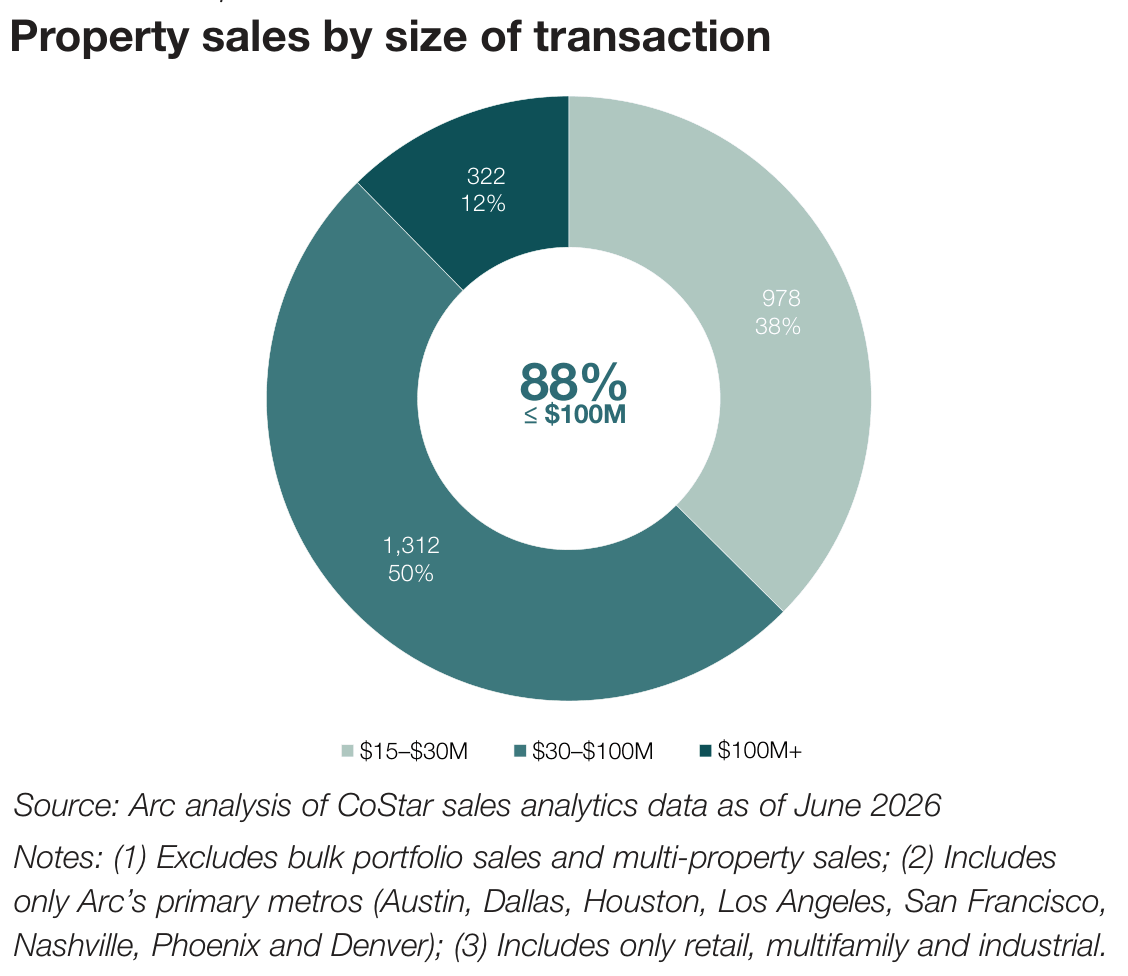
Property sales by size of transaction
Redefining liquidity demand
Real estate demand is often treated as a single statistic, but three distinct forms of demand are driving current market activity, and only one concerns the property itself.
The first is demand for the underlying real estate, driven by demographic and economic fundamentals such as job growth and household formation — factors that evolve gradually.
The second is sponsor demand for capital. As capital market dislocation has persisted amid higher interest rates, elevated inflation and cautious Federal Reserve policy, sponsors have increasingly sought alternatives to a cash-in refinancing or sale.
The third is demand from institutional limited partners, who are increasingly weighing distribution pacing against back-ended total returns. According to Bain’s Global Private Equity Report 2026, distributions to investors remained stubbornly low in 2025, reflecting a pattern seen across private markets broadly, not just real estate.
Structures capable of generating cash flow ahead of a final capital event have become more attractive as a result. GP-led recapitalizations at the asset level, in which a sponsor brings in new capital rather than selling outright, can provide limited partners with a partial realization and return of capital while preserving additional upside.
Structured equity in practice
Structured equity can provide a capital alternative for strong sponsors with unstable capital stacks through GP-led recapitalizations at the asset level.
For example, Arc recapitalized a necessity-retail center in Southern California anchored by a specialty grocer. The property was well leased when its ownership group faced a loan maturity default after testing the sale market and finding pricing that would require a material loss of equity. By the time the recapitalization closed, leverage on the property had climbed above 85 percent of value, and higher rates had pushed annual debt service high enough that the property’s debt–service coverage ratio fell below lender requirements — a combination no conventional lender would refinance.
Rather than pursue a forced sale at depressed pricing, Arc structured a GP-led, asset-level recapitalization as preferred equity to delever the property while preserving the sponsor’s path to equity recovery. The center went on to achieve additional income growth under the recapitalized ownership structure, ultimately generating an exit that returned equity to the sponsor after repayment of the structured equity position.
Arc invested in a similar opportunity with a newer-vintage multifamily property in Texas. The ownership group was unable to refinance the full loan balance at prevailing rates and, after a sale process produced pricing insufficient to retire the outstanding debt, faced a material maturity shortfall that required a loan restructuring. Arc then collaborated with the sponsor to pay down and extend the loan with structured equity, at a basis that reflected more than a 25 percent discount to the property’s replacement cost.
Recapitalizations such as this typically require skilled negotiations with lenders and sponsors, often through existing relationships, because the balance and tenor of those discussions differ from a traditional financing. Because the structured equity investment retains downside protection through its attachment point, Arc’s position was insulated from some of the asset’s near-term operating risk.
Both situations shared a common thread: An asset with strong or improving underlying fundamentals, a discount to replacement cost or intrinsic value, and a sponsor facing a binary choice between losing equity and finding an innovative capital partner.
In the current environment, this combination can offer a different risk profile than traditional equity strategies that rely on distressed properties requiring complex turnarounds or ground-up developments requiring entitlement and construction exposure to target comparable returns. Structured equity investors focus on broken capital stacks rather than broken assets.
Looking ahead
Interest rates are unlikely to return to the near- zero levels of the pre-2022 era, and S&P Global Market Intelligence estimates more than $1.25 trillion in commercial real estate loans will mature in 2027 alone, further compounding the 2025–2026 maturity wall. That maturity wall, combined with continued bid-ask spreads and a still-recovering transaction market, suggests sponsor demand for solution-oriented structured equity could persist for years rather than resolve quickly.
Reset basis, subordinated equity and strong governance together can provide meaningful downside protection while preserving the potential for equity-like returns. This combination has made structured equity a viable solution for addressing maturity challenges in this cycle. For institutional investors, it can offer another way to pursue equity returns while managing risk.
Source: Institutional Real Estate Americas, October 2026, pages 42–44